Trust Report Canada · November 2026
If you run a Facebook page for a business, you have probably had a message like this one.
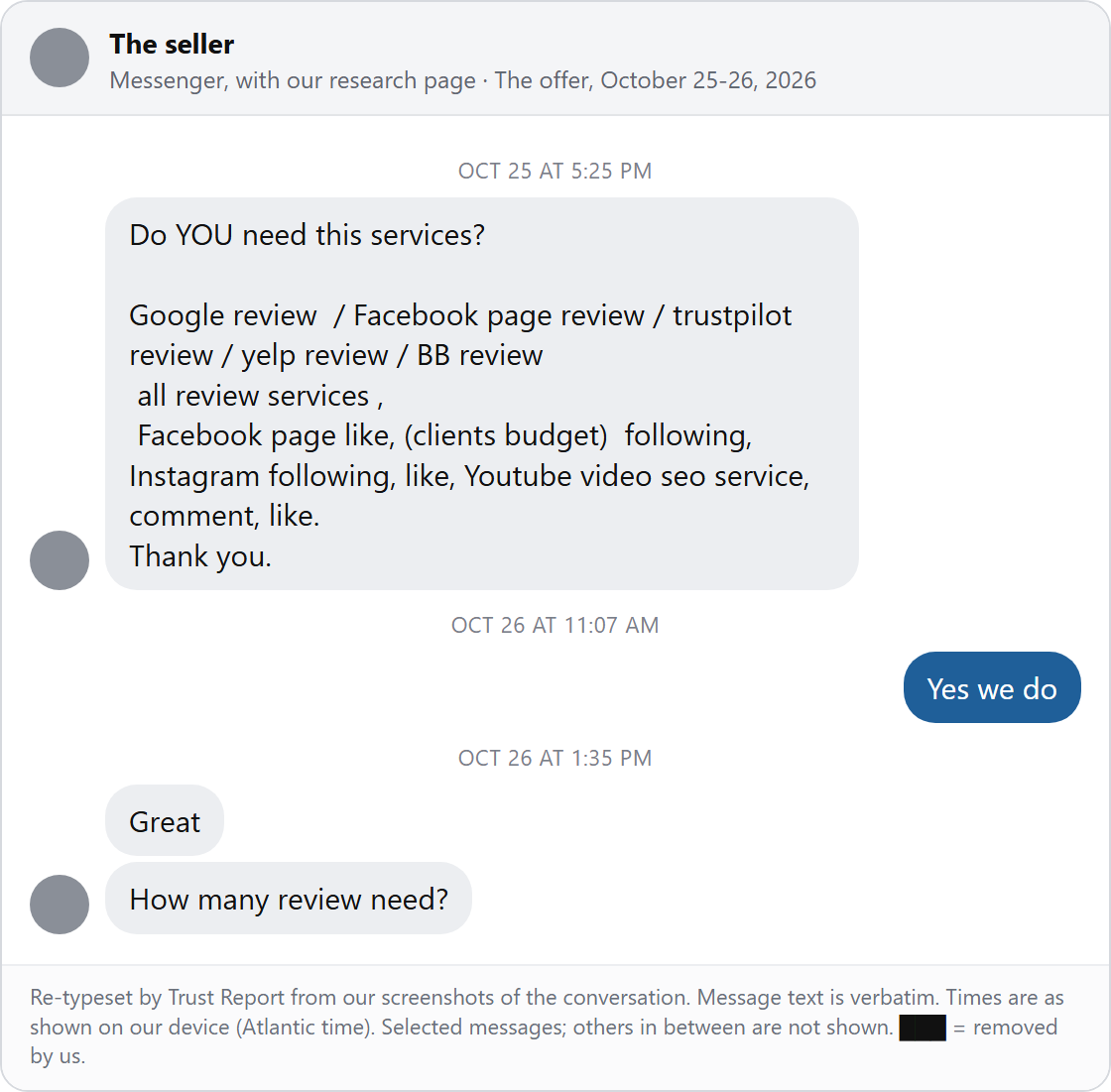 The message our page received on October 25, 2026. Chat images here are re-typeset from our screenshots; the black bars are ours.
We answered as a customer, so you don’t have to. Here’s what happens when you say yes.
1. You get a free review, from a stranger
He offered a free trial. We told him to post on our own page. A day later a review appeared from an account we had never heard of.
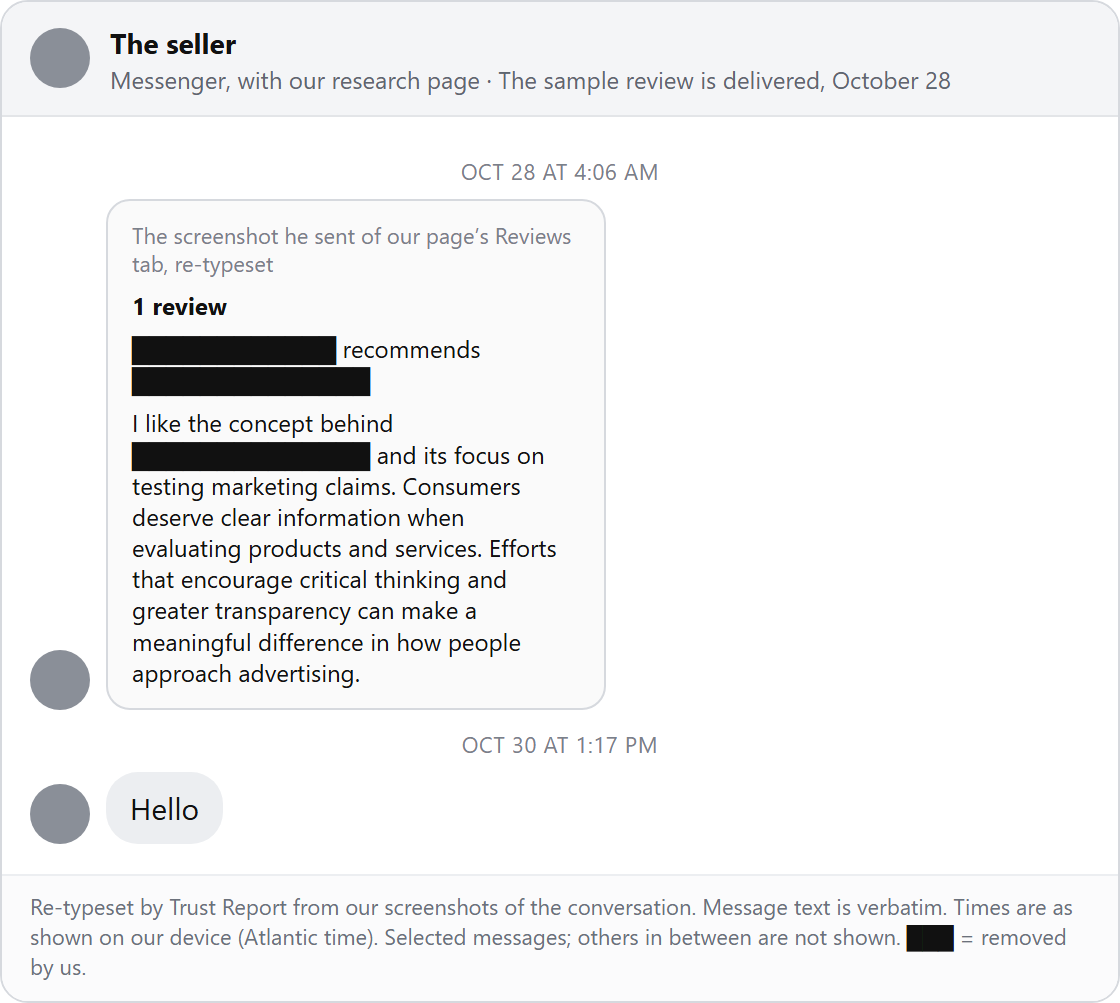 The “free sample”. The account behind it has recommended six other small businesses across the UK.
2. You get a price list
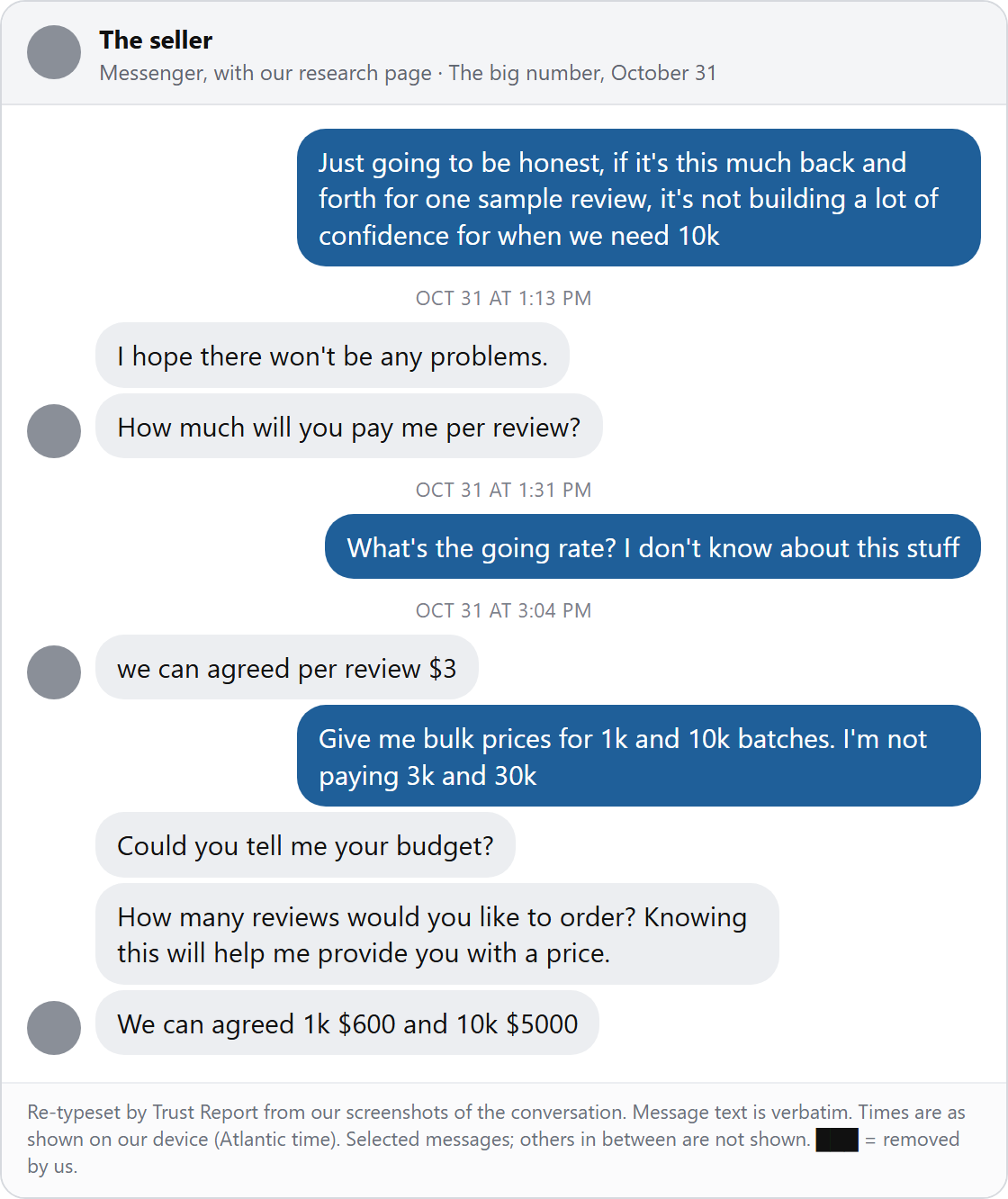 Fifty cents a review, if you buy enough.
3. He wants to be paid where you can’t get your money back
He asked for Western Union, Remitly, Ria or cryptocurrency, then sent a Bitcoin address and a UK bank account. He also asked, again and again, for a photo of our payment. We never paid.
4. He asks for your accounts
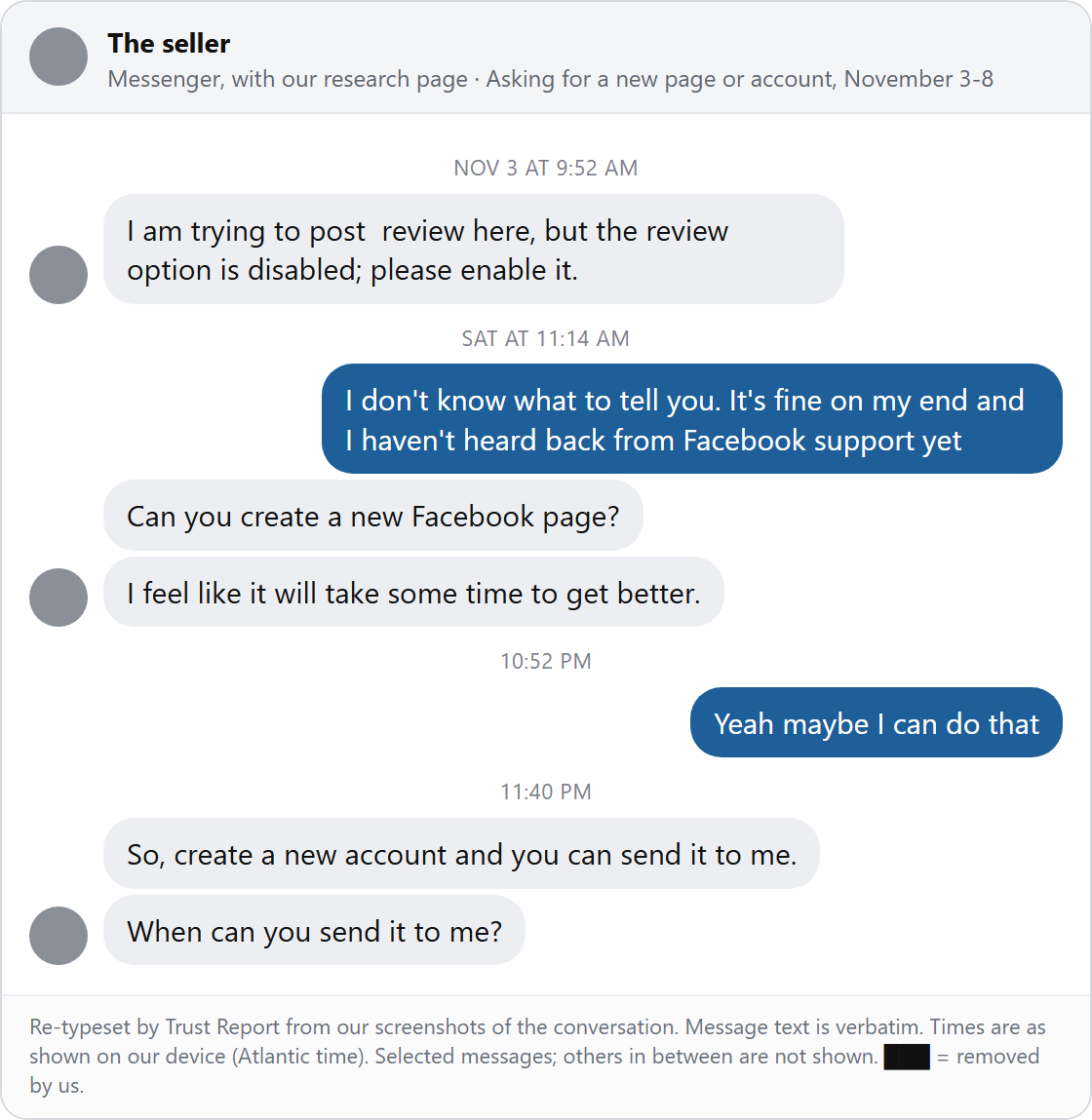 When our page stopped taking his reviews, he asked us to make him a new page or account.
This is the part to remember. A page or account you create and hand over becomes a tool for posting reviews on someone else’s business. We didn’t, and you shouldn’t.
Why it matters
Bought reviews fool the customers who read them, and they hurt the honest business down the street that earned its reviews one job at a time. In Canada, the Competition Bureau treats reviews that don’t come from real customers as misleading marketing.
What to do
- Don’t reply, and don’t take the free trial.
- Report the message and the profile on Facebook: open the chat’s settings and choose Report, then report the profile from its three-dot menu.
- Never create or hand over a page or an account for anyone.
- Got a review you didn’t earn? Report it rather than deleting it, so the platform can see who posted it.
- Reading reviews? Tap the reviewer. Someone who recommends a roofer, a plumber and a marketing agency in different parts of the country is worth a second look.
- Report it to the Competition Bureau, and tell us at [email protected].
What we did
We reported the account, the review and the payment details to Meta, the RCMP and the Canadian Anti-Fraud Centre, the Competition Bureau, and the payments company that holds the bank account. Our record of the account is in our wiki: Review seller (TRC-015).
The full method, including how we got him to share his payment details and the form we built to do it, is written up by Mike: Wright (2026), Honeypot Buyer: an inside look at the coordinated inauthentic behaviour economy.